
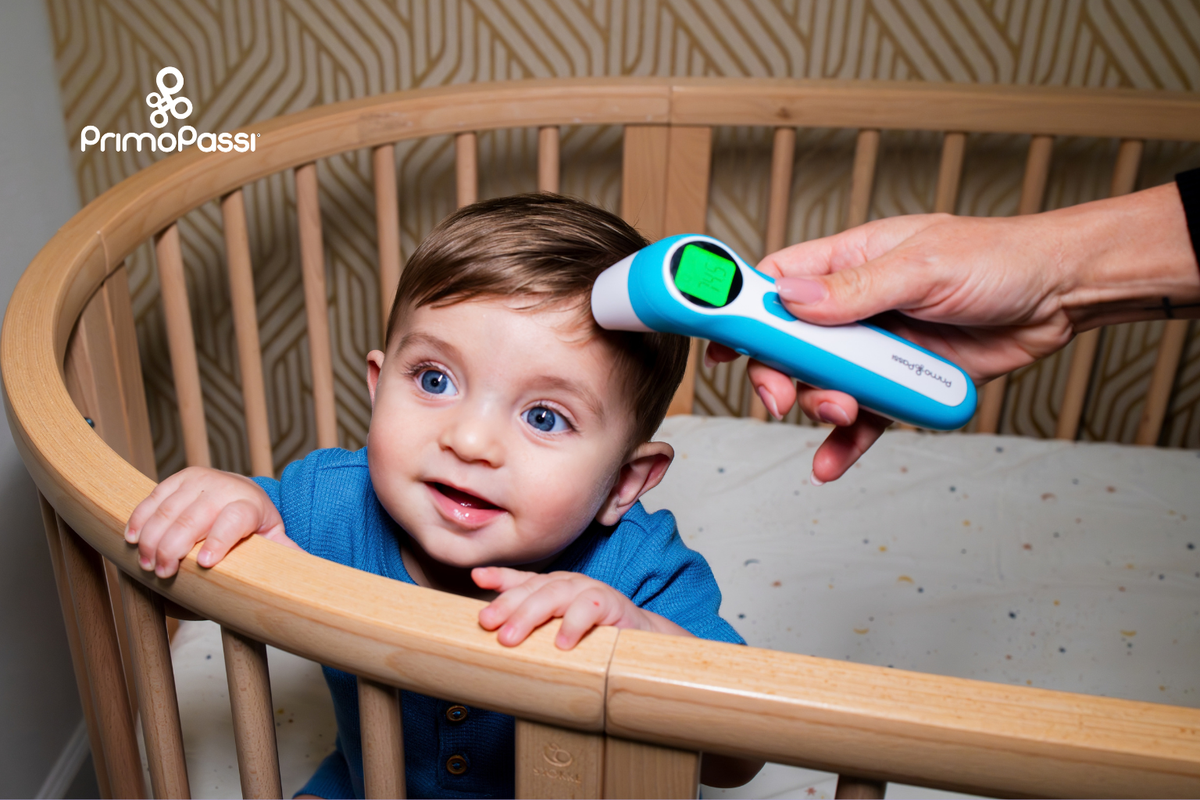
Quick Answer: A fever in babies and toddlers is a temperature of 100.4°F (38°C) or higher taken rectally, in the ear, or on the forehead. What you do next depends on age. Any fever in a baby under 3 months means calling the doctor or going to the emergency room right away, while older babies and toddlers are judged by the number, how long it lasts, and how they act. Armpit and oral readings use lower cutoffs, and a child who is hard to wake, struggling to breathe, or refusing all fluids needs medical care at any temperature.
If your little one feels warm, the first question is almost always the same: what temperature is a fever in babies, and how worried should you be? Pediatric guidelines use 100.4°F (38°C) as the line for fever in babies and toddlers, but the right response changes a lot between a 6-week-old and a 2-year-old. This guide gives you a fever temperature chart by age, shows how to take an accurate reading, and spells out the signs that mean it is time to call the doctor or head to the ER.
What Temperature Is a Fever in Babies and Toddlers?
A fever is a rise in body temperature above the normal range, and it usually means the immune system is fighting an infection. It is a symptom, not an illness on its own. The American Academy of Pediatrics (AAP) defines fever as a temperature of 100.4°F (38°C) or higher when measured rectally, in the ear, or on the forehead. Other spots on the body read a little cooler, so the cutoff changes with the method.
| Measurement method | Fever starts at | Good to know |
|---|---|---|
| Rectal | 100.4°F (38°C) | Considered the most accurate method for infants and young toddlers |
| Ear (digital) | 100.4°F (38°C) | Becomes more reliable as the ear canal grows, usually around 6 months |
| Forehead (temporal) | 100.4°F (38°C) | Quick and gentle, and generally used from about 3 months |
| Oral (under the tongue) | 100°F (37.8°C) | Only for older children who can hold the thermometer correctly |
| Armpit | 99°F (37.2°C) | The least accurate option, best used as a quick screen |
Normal body temperature for most healthy children sits somewhere around 97°F to 99.5°F (36.1°C to 37.5°C). It naturally climbs in the late afternoon and can read higher after a warm bath, heavy bundling, or active play. A single slightly high number is not automatically a fever, which is why it helps to wait 15 to 20 minutes and measure again before deciding what to do.
Fever Temperature Chart by Age
Use this baby fever chart as a quick reference. The temperatures below apply to rectal, ear, or forehead readings. Guidelines vary slightly between doctors and health organizations, so if your pediatrician has given you different instructions, follow those first.
| Age | Fever temperature | What to do |
|---|---|---|
| Under 3 months | 100.4°F (38°C) or higher | Call the doctor or go to the emergency room right away, even if your baby looks well |
| 3 to 6 months | 100.4°F (38°C) or higher | Call your pediatrician the same day. Seek urgent care for 102°F (38.9°C) or higher, or if your baby is unusually sleepy or fussy |
| 6 to 24 months | 100.4°F (38°C) or higher | Call if the fever lasts more than 24 hours, climbs above 102°F (38.9°C), or comes with other symptoms |
| 2 to 3 years and older toddlers | 100.4°F (38°C) or higher | Call if the fever lasts more than 3 days, or if your toddler seems very unwell |
| Any age | 104°F (40°C) or higher | Call your doctor, especially if it keeps coming back |
Age matters because young babies cannot fight infections the way older children can, and a fever may be the only early sign that something serious is happening. As children get older, how they look and act becomes just as important as the number on the thermometer.
Fever in Newborns and Babies Under 3 Months
For a baby under 3 months, a temperature of 100.4°F (38°C) or higher is treated as a medical emergency. Do not wait to see if it comes down on its own, and do not give fever medicine before speaking with a doctor. Young infants can develop serious bacterial infections quickly, and doctors usually want to examine them and run tests even when the baby seems calm and feeds normally.
A temperature that is unusually low can also be a warning sign in a newborn. If your baby feels cold, is hard to warm up, or has a low reading along with poor feeding or sleepiness, call the doctor the same way you would for a fever.
At this age, a rectal reading gives the most dependable number. If you took a forehead or ear reading and it looks high, confirm it and call. Your pediatrician's office will tell you whether to come in or go straight to the ER.
Fever in Babies 3 to 6 Months
From 3 months on, a fever is still worth a phone call, but the picture is less urgent if your baby is otherwise acting like themselves. A baby who is feeding, making eye contact, and having wet diapers is a very different case from one who is limp, inconsolable, or refusing to eat.
- Call your pediatrician the same day for any temperature of 100.4°F (38°C) or higher.
- Seek urgent care if the temperature reaches 102°F (38.9°C) or higher.
- Seek care right away if your baby is unusually drowsy, extremely irritable, or hard to wake, whatever the number says.
Babies in this range have often had their first round of vaccines, and a low-grade fever for a day or so afterward is common. Even so, ask your doctor what to expect so you can tell the difference between a normal vaccine reaction and something else.
Fever in Babies 6 to 24 Months
This is the age when fevers show up most often. Babies in this window are meeting new germs at daycare, at family gatherings, and by putting everything in their mouths. Most fevers are caused by common viral infections, such as colds, and pass within a few days.
The AAP advises calling the doctor if a fever lasts longer than 24 hours in a child younger than 2, even when the child seems fine otherwise. Call sooner if the temperature goes above 102°F (38.9°C) or if there are other symptoms like ear pulling, a cough that worsens, vomiting, diarrhea, or a rash.
Teething is a common suspect, but it does not cause a true fever. It may nudge the temperature up slightly, so a reading of 100.4°F (38°C) or above should be treated as a fever and not blamed on new teeth.
Fever in Toddlers 2 to 3 Years and Older
Toddlers handle fevers better than babies, and the way a toddler behaves tells you more than the exact temperature. A toddler with a 102°F fever who is drinking, playing a little, and resting comfortably is usually less of a concern than a toddler with a 100.6°F fever who is listless and will not drink.
Call the doctor if a toddler's fever lasts more than 3 days, if it rises to 104°F (40°C) or higher more than once, or if it keeps returning after going away. Also call if your toddler complains of a stiff neck, severe headache, ear pain, pain when urinating, or a sore throat that makes swallowing hard.
How to Take a Baby or Toddler's Temperature Accurately
A reliable number is the foundation of every decision in this guide, so the method and the thermometer both matter. Wait at least 15 minutes after a bath, a feeding, or a stint under heavy blankets, and take the reading while your child is calm. Crying and squirming can raise the number.
- Rectal: Use a digital rectal thermometer with lubricant, insert only the tip, and hold your baby securely. This is the go-to method for infants and the best choice when the exact number will drive a medical decision.
- Forehead: Hold a temporal or non-contact thermometer at the distance listed in its manual and keep the area free of sweat and hair.
- Ear: Pull the ear gently back and straight, and point the probe toward the eardrum. Earwax and a poor angle can throw off the result.
- Armpit: Keep the thermometer snug in the armpit with the arm held down. Use this only as a rough screen, and confirm a high number with another method.

For quick checks, many parents like a thermometer that does not wake a sleeping child. The Primo Passi Non-Contact Ear & Forehead Thermometer 8-in-1 reads in about one second, switches between forehead and ear mode depending on whether the probe cover is on, and includes a fever warning indicator and a 10-reading memory so you can show your pediatrician how the temperature has changed. Its manual recommends ear mode for babies over 3 months, so follow the instructions that come with your device.
Whatever device you use, write down the temperature, the method, and the time. If you end up calling the doctor, that short log saves guesswork and helps them give better advice.
Warning Signs: When a Fever Is an Emergency
Go to the emergency room or call emergency services if a child with a fever shows any of these signs, whatever the temperature:
- Trouble breathing, fast breathing, or visible effort to breathe
- Skin, lips, or nails that look blue, gray, or very pale
- A stiff neck, or crying hard when the neck is moved
- A rash of purple or red spots that does not fade when pressed
- A seizure, or a child who is very difficult to wake
- Inconsolable crying, or being unusually floppy and limp
- Signs of dehydration: no wet diaper in 8 hours, no tears when crying, a dry mouth, or a sunken soft spot on a baby's head
- A fever in any baby under 3 months
Trust your instincts here. Parents know their children well, and if something feels wrong even though the number looks low, calling the doctor is always a reasonable choice.
How to Keep a Baby or Toddler With a Fever Comfortable
The goal of dealing with a fever is comfort, not getting the temperature to a specific number. A fever is part of how the body fights germs, and a child who is drinking and resting well often does not need medicine at all.
- Offer fluids often. Breast milk, formula, or water for babies who have started on water and older toddlers all help prevent dehydration. Small, frequent sips work better than big drinks.
- Dress lightly. One thin layer is usually enough. Heavy blankets and extra clothing can trap heat and push the temperature higher.
- Keep the room comfortable. A cool, calm room helps, and a lukewarm sponge bath can soothe a fussy toddler. Skip cold baths, ice, and alcohol rubs.
- Let them rest. Quiet time and extra cuddles matter more than activity.
- Ask before giving medicine. Do not give fever medicine to a baby under 3 months unless a doctor tells you to. Always dose by weight, follow the label, and ask your pediatrician or pharmacist if you are unsure.

Some parents also like having something soothing on hand for a warm, fussy child. The Primo Passi Baby Cool Relief Patch is a soft gel pad that can be cut to size and placed on the forehead for cooling comfort, with no refrigeration needed. Check the age guidance on the package before use. Patches help your child feel more comfortable, but they do not replace a call to the doctor when one is needed.
Fever and Febrile Seizures
Between about 6 months and 5 years of age, a small share of children have a febrile seizure when their temperature rises quickly. Seeing one is frightening, but most last only a minute or two and do not cause lasting harm. Lay your child on their side on a soft surface, keep the area clear, and never put anything in their mouth. Call emergency services if the seizure lasts more than 5 minutes, and tell your doctor about any seizure, even a brief one.
Checking on Your Child Overnight
Fevers tend to feel worse at night, and parents often end up checking every hour. If your little one is sleeping in another room while sick, a monitor such as the Primo Passi Smart Baby Monitor lets you see and hear them without opening the door. Even so, a monitor never replaces in-person checks when your child is unwell.
Quick Reference: Baby and Toddler Fever Cheat Sheet
- Fever means 100.4°F (38°C) or higher by rectal, ear, or forehead reading.
- Under 3 months: any fever means calling the doctor or going to the ER immediately.
- 3 to 6 months: call the same day, and seek urgent care at 102°F (38.9°C) or higher.
- 6 to 24 months: call if the fever lasts over 24 hours or rises above 102°F (38.9°C).
- 2 to 3 years and older: call if the fever lasts more than 3 days.
- At any age: call for 104°F (40°C) or higher, and go to the ER for breathing trouble, a stiff neck, a seizure, or a child who is hard to wake.
- Behavior matters as much as the number. Drinking, playing, and wet diapers are good signs.
For more detail on how fever is defined and managed in children, see the guidance from HealthyChildren.org, the AAP's parenting site. This article is general information and not a substitute for medical advice from your child's doctor.
Frequently Asked Questions About Fever in Babies and Toddlers
What temperature is a fever for a baby?
A fever in a baby is a temperature of 100.4°F (38°C) or higher when measured rectally, in the ear, or on the forehead. For an armpit reading the cutoff is lower, at 99°F (37.2°C). Any baby under 3 months with a temperature at or above 100.4°F needs to be seen by a doctor right away.
What temperature is a fever for a toddler?
A toddler has a fever at 100.4°F (38°C) or higher by rectal, ear, or forehead reading. Most toddler fevers come from common viral infections and are managed at home with fluids, rest, and light clothing. Call the doctor if the fever lasts more than 3 days, reaches 104°F (40°C) or higher, or comes with worrying symptoms.
What fever temperature requires the ER for a baby?
Go to the ER for any temperature of 100.4°F (38°C) or higher in a baby under 3 months. For older babies and toddlers, go to the ER when a fever comes with trouble breathing, a stiff neck, a seizure, a rash that does not fade when pressed, extreme sleepiness, or signs of dehydration, whatever the number is.
Is 99°F a fever in a baby?
A 99°F reading by rectal, ear, or forehead is within the normal range and is not a fever. An armpit reading of 99°F (37.2°C) is the AAP's lower cutoff for fever by that method, so it is worth rechecking with a more accurate method if your baby seems unwell.
Can teething cause a fever in babies?
Teething may cause a slight rise in temperature, but it does not cause a true fever. If your baby's temperature reaches 100.4°F (38°C) or higher, look for another cause and follow the guidance for their age instead of blaming teething.
How long does a fever last in babies and toddlers?
Most fevers from common viral infections last 2 to 3 days. Call the doctor if a fever lasts more than 24 hours in a child under 2, or more than 3 days in a child 2 or older, or if it goes away and then returns.
This article was last reviewed in October 2026 and is intended for general educational purposes. Always follow the instructions on product packaging and the advice of your child's healthcare provider.